Water Security

Importance and Mission
As Sansiri's business is interconnected with water resources throughout the value chain, the Company acknowledges and prioritises the reduction of its operational impacts on water usage.
This encompasses the extraction of water from natural sources, which may affect ecosystems if excessive amounts are utilised, potentially harming surrounding communities. Additionally, the discharge of wastewater into the environment could negatively influence local aquatic habitats. The Company is dedicated to improving water use efficiency and wastewater management, both at the corporate and project levels.
Supporting the Sustainable Development Goals
SDGs 3
SDGs 6
Goals and Performances
Reduce water consumption intensity at company-level by 6% within 2030 compared to the base year 2024.
-
Reduce water consumption intensity at the Siri Campus and Plus Property Headquarter by 6% within 2030 compared to the base year 2024
-
Reduce water consumption intensity at the Precast Factory by 6% within 2030 compared to the base year 2024
-
Reduce water consumption intensity at The Standard Huahin by 6% within 2030 compared to the base year 2024
-
Reduce water consumption intensity at The Peri Huahin by 6% within 2030 compared to the base year 2024
-
Reduce water consumption intensity at The Peri Khaoyai by 6% within 2030 compared to the base year 2024
-
Reduce water consumption intensity at Habito Mall by 6% within 2030 compared to the base year 2024
In 2025, water consumption intensity at company-level reduced by
10%
compared to 2024.
-
In 2025, water consumption intensity the Siri Campus increased by 116% compared to 2024
-
In 2025, water consumption intensity at the Precast Factory reduced by 15% compared to 2024
-
In 2025, water consumption intensity at The Standard Huahin reduced by 6% compared to 2024.
-
In 2025, water consumption intensity at The Peri Huahin increased by 74% compared to 2024
-
In 2025, water consumption intensity at The Peri Khaoyai reduced by 62% compared to 2024
-
In 2025, water consumption intensity at Habito Mall increased by 18% compared to 2024
50% of Sansiri’s low-rise projects have specified water management plans that utilise a water recycling system as one of the management methods.
80%
of the low-rise projects have specified water management plans that utilise a water recycling system.
Management Approach
Sansiri recognises the significance of water resources and the management of water usage within the project areas and neighboring regions.
Consequently, the Company conducts comprehensive water-related risk assessments prior to project development and refrains from operating in water stressed areas. Additionally, it prioritises the selection of water sources utilised in projects that do not adversely affect water users in the surrounding areas and establishes contingency plans to guarantee business continuity in the event of water shortages. Concurrently, the Company sets specific targets for reducing water consumption and actively encourages stakeholders to engage in water conservation initiatives.
Water Management Plan
Sansiri develops a comprehensive Water Management Plan for all projects identified as being at risk of water scarcity or located in areas prone to such conditions. This initiative is designed to prevent environmental impacts and mitigate potential risks. The company complies with pertinent environmental laws, regulations, and standards, as well as international practices, throughout every stage of project development, including design, construction, occupancy, and maintenance.
Furthermore, the Company evaluates water usage, the potential for water recycling, and water resource risks across each area, considering the viability of upstream water sources and the potential impacts on adjacent communities. This information is utilised in project planning and design to ensure a balanced approach to water usage that maintains water security in the region. The Company also monitors project performance, facilitating enhancements in processes and the development of new initiatives that prioritise water efficiency in the long term.
Risk Assessment
Sansiri performed a water risk assessment utilising the World Resources Institute (WRI) Aqueduct tool. The assessment indicated that 58 projects are situated in areas characterised by a moderate to high level of water stress, while 50 projects are classified in a moderate level.
Water Risk Level
Overall Risk
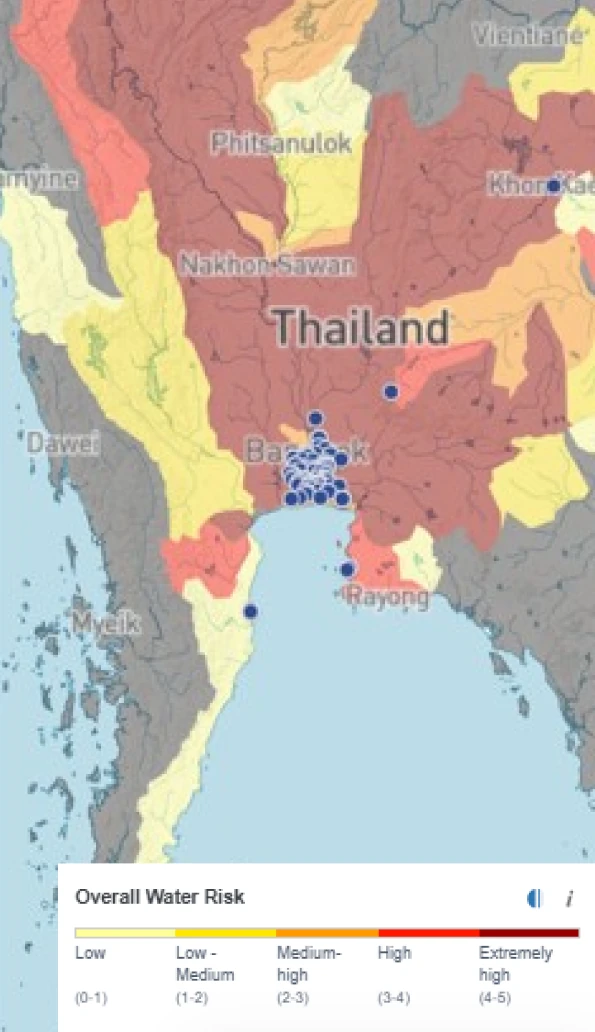
- Setthasiri Serithai
- Anasiri Tientalay 30
- Siri Place Prachauthit 75
- Precast Factory
- Condo Me Bang Bo Building H
- Peri Huahin
- The Standard Huahin
- Canvas cherngtalay soi 3 P1
- Setthasiri Kohkaew
- Saransiri Kohkaew 2
- The Base Bang Don
- Dcondo Kathu 2
Water Stress
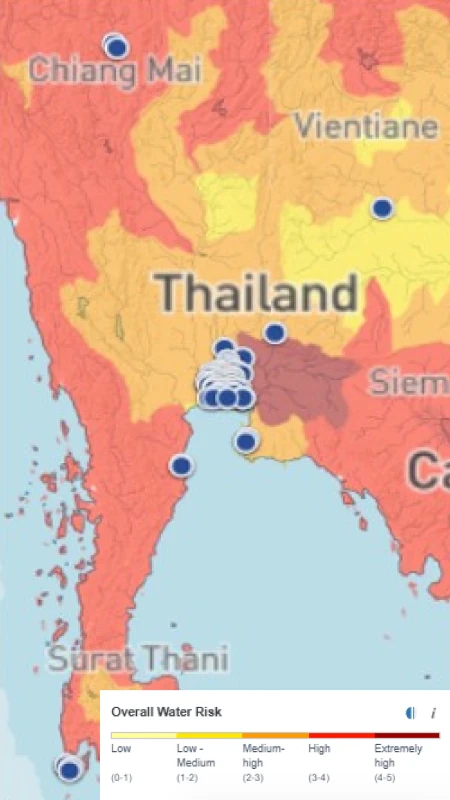
Water stress is an indicator of competition for water resources and is defined informally as the ratio of demand for water by human society divided by available water.
- Pattaya Photisan P.2
- K-Series Potisan (Condo me Potisan)
- Saransiri Srinakarin Phraeksa
- Mabel Bangna Km 26
- Condo Me Bang Bo Building H
- The Base Ban Don
- Setthasiri Kohkaew
- Saransiri Kohkaew 2
- D-condo Kathu 2
- Canvas cherngtalay soi 3 P1
Furthermore, to ensure effective operations in water-stressed areas, the Company emphasises the continuous engagement of stakeholders within its operational domains. This is accomplished by actively listening to feedback from neighbouring communities and strategically planning water resource management within its projects to mitigate potential issues for the surrounding communities and establish a sustainable balance in the collective use of water resources.
For wastewater management, Sansiri mandates that wastewater generated from the Company’s business operations is to be managed in compliance with applicable laws and various industry standards, including ISO 14001:2015 for the precast factory. In addition, Sansiri follows measures outlined in the Environmental Impact Assessment (EIA) report by implementing appropriate wastewater treatment systems and conducting regular monitoring of wastewater quality to mitigate environmental and community impacts.
To affirm Sansiri’s commitment to sustainable and effective water management, the Company has established clear targets relative to the base year. The performance will be continuously monitored and evaluated to ascertain whether the Company has successfully reduced water usage or utilised water efficiently as intended.
Key Performances
Performance of the Water Efficiency Projects
Unit: (Cubic Metre / Square Metre)

Unit: (Cubic Metre / Square Metre)
| Water consumption rate per area | 2022 | 2023 | 2024 | 2025 |
|---|---|---|---|---|
| Siri campus | 0.496 | 0.247 | 0.307 | 0.663 |
| Habito mall | 0.270 | 0.037 | 0.041 | 0.048 |
| The Peri Hotel Khaoyai | 2.107 | 7.332 | 3.509 | 4.825 |
| The Peri Hotel Huahin | 0.408 | 0.409 | 0.362 | 0.631 |
| The Standard Huahin | N/A | 3.306 | 2.519 | 2.214 |
| Precast factory | 1.474 | 0.783 | 0.761 | 0.647 |
Relevant Stakeholders

Investor and Shareholders

Community and Society

Suppliers and Business Partners

Government Agencies