
Climate Change

Importance and Mission
The risks and impacts associated with climate change and natural disasters are increasingly severe and pronounced. These factors necessitate various agencies strive for net-zero greenhouse gas emissions.
Consequently, both public and private organisations, at national and international levels, must prioritise serious engagement with these challenges. Furthermore, the business sector must adapt to meet the expectations of a new generation of consumers who value environment and sustainability. This adaptation requires the development of business practices, products, and services that address these challenges, which affect multiple dimensions, including economic, societal, environmental, and human rights considerations, such as the right to a good quality of life and equitable access to resources. These impacts arise from a variety of human activities, including those associated with business operations.
Although real estate development is not a major direct contributor to greenhouse gas emissions, activities within the value chain, including electricity consumption by residents, the production of construction materials by suppliers or contractors, and the transportation of materials and equipment impact greenhouse gas emissions and the climate. Consequently, Sansiri is dedicated to facilitating the transition to a low-carbon society by prioritising climate change mitigation across all sectors of its business operations. This commitment aims to foster environmental sustainability and align with the expectations of stakeholders at all levels.
Supporting the Sustainable Development Goals
SDGs 7
SDGs 11

SDGs 13
Goals and Performances
Goals and Roadmap to achieving Net Zero Goal
To reaffirm the Company’s commitment to climate change action, Sansiri has become the first real estate company in Thailand to establish a goal of achieving net-zero greenhouse gas emissions by 2050, while also setting short- and medium-term targets to facilitate tangible progress.
Sansiri has conducted a thorough assessment of greenhouse gas (GHG) emissions in compliance with international standards. The Greenhouse Gas Protocol: A Corporate Accounting and Reporting Standard (2004) serves as the principal framework for compiling and reporting GHG emissions data. Additionally, Sansiri has integrated certain greenhouse gas emission calculation factors from the Thailand Greenhouse Gas Management Organization (Public Organization) (TGO) to account for the national context. These factors include carbon dioxide (CO2), methane (CH4), nitrous oxide (N2O), perfluorocarbons (PFCs), hydrofluorocarbons (HFCs), nitrogen trifluoride (NF3), and sulfur hexafluoride (SF6).

| Sansiri Net-Zero Target | ||||
|---|---|---|---|---|
| 2022 | 2025 | 2030 | 2040 | 2050 |
| Base Year (Scope 1,2,3) |
Reduce GHG emission (Scope 1,2,3) |
Reduce GHG emission (Scope 1,2,3) |
Reduce GHG emission (Scope 1,2,3) |
Net Zero Organisation (Scope 1,2,3) |
| 16% | 42% | 70% | ||
| 2,397,531 tCO2e |
2,013,926 tCO2e |
1,390,568 tCO2e |
719,259 tCO2e |
|
* This target was established by Sansiri in 2025 to enhance its sustainability operations and facilitate measurable reductions in greenhouse gas emissions.
** The goals align with the country's Long-Term Low Emissions Development Strategy (LT-LEDS), which seeks to achieve carbon neutrality by 2050.
The Company continuously monitors and reviews its climate change performance, enabling relevant stakeholders to track and provide feedback on its operations. This information is considered for regular improvements and developments in its climate change initiatives, ensuring that the approach aligns with its goals and long-term sustainability.
To meet the Company’s greenhouse gas emission reduction targets, Sansiri has implemented a framework to address and mitigate the impacts and risks associated with climate change, considering key corporate activities that influence climate change, from planning and construction to customer usage. The details are as follows:
To achieve the greenhouse gas emission reduction target, Sansiri has implemented a systematic Decarbonisation Strategy aimed at reaching net-zero greenhouse gas emissions by 2050. This strategy encompasses both internal operations (Scope 1 and 2) and supply chains, as well as customer product usage (Scope 3). It includes an analysis of the primary sources of greenhouse gas emissions and the development of measurable emission reduction initiatives, along with the assessment of each initiative's contribution to the Company’s overall target.

1. Internal Operation
An analysis of Sansiri's internal greenhouse gas emissions indicates that the primary sources in Scope 1 arise from the use of fuel in company vehicles, fuel combustion in equipment, and refrigerants. Scope 2 is associated with electricity consumption in office buildings and other projects, which remains dependent on the grid, resulting in elevated carbon emissions.
To address these critical sources, the company has implemented the following initiatives:
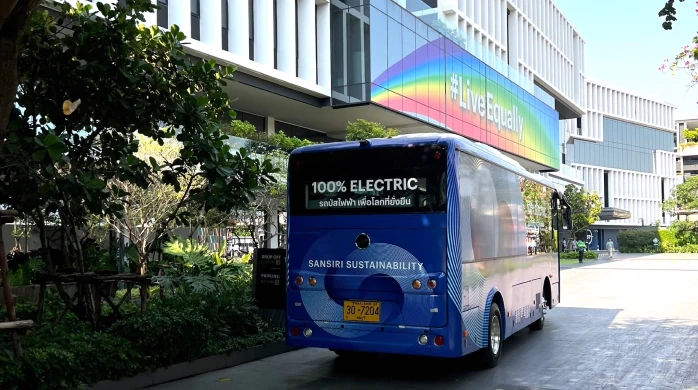
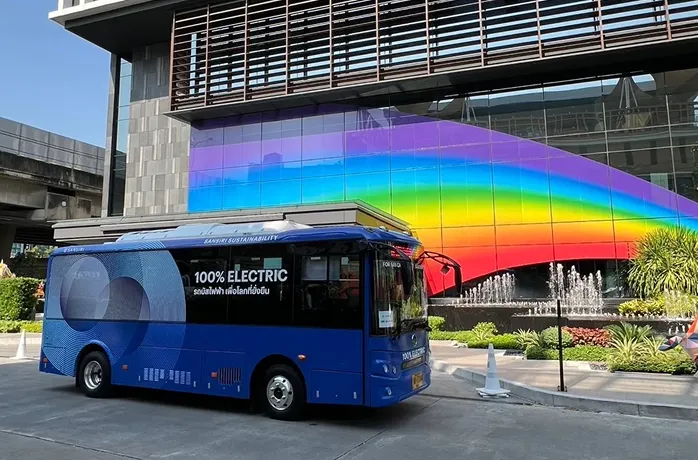
Transitioning company vehicles to electric models
With an ambition to achieve 100 percent conversion by 2025.

Minimising greenhouse gas emissions from refrigerants and fuel combustion in equipment
The Company has commenced the shift to low-carbon fuels, such as B10 and B20 diesel, alongside the adoption of environmentally friendly refrigerants.

Enhancing energy efficiency in buildings
With specific reduction targets of 10 percent by 2025, 15 percent by 2033, and 30 percent by 2050. This will be facilitated through energy audits, equipment upgrades, thermal design, and the implementation of automated energy control systems.
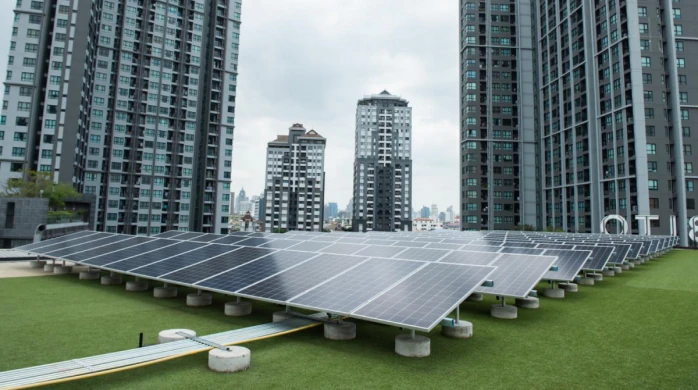
Advancing the utilisation of renewable energy
The Company aims to source 100 percent of its electricity from renewable energy by 2050, through the installation of solar panels, procurement via long-term power purchase agreements, and the use of renewable energy certificates when direct access to clean energy is unavailable.
Furthermore, the Company intends to foster behavioural changes within the organisation to support ongoing reductions in energy consumption and greenhouse gas emissions. This will be accomplished by establishing clear sustainability targets and conducting initiatives to enhance awareness and engage employees at all levels through education, transparent communication, motivation, and the creation of avenues for feedback and innovation.
2. Supply chain and Products
In evaluating greenhouse gas emissions in Scope 3, it was identified that primary emission sources stem from the use of construction materials in projects and the energy consumed by occupants in the buildings developed by the Company. These factors contribute a more significant share of emissions and present greater complexities than internal organisational operations.
To effectively manage emissions across the value chain and throughout the product lifecycle, The Company has instituted several key measures, including:

Procurement of Low-Carbon Materials
With an ongoing commitment to increasing the proportion of such materials. The targets include utilising 20 percent low-carbon materials by 2025, increasing to 50 percent by 2033, and achieving 50-100 percent by 2050.

Design of Energy-Efficient Products
Aiming for all newly developed projects to incorporate energy efficiency principles by 2050, with expectations to reduce energy consumption by up to 67 percent compared to 2022 levels.

Integration of Renewable Energy Systems in New Products
Specifically targeting the installation of renewable energy systems, such as solar PV, in all new residential properties to meet 21 percent of energy consumption by 2050.
The Company prioritises engagement with the partners in supply chain by implementing sustainable procurement guidelines and developing selection criteria that emphasise environmental responsibility. The Company seeks to collaborate with its partners to facilitate the systematic transition to low-carbon materials, particularly in high-carbon footprint categories such as cement, metal, furniture, and decorative materials, which are essential components of the Company's real estate development projects.
To support The Company’s product-level greenhouse gas emission reduction target, the Company has launched a pilot project, "Sansiri Sustainable Home – Prototype 1," in collaboration with 18 supply chain partners. This initiative aims to develop a home design utilising low-carbon construction materials, achieving a reduction in greenhouse gas emissions from materials by up to 35 percent. Additionally, it is designed for high energy efficiency, decreasing energy consumption by up to 83 percent and incorporating solar power generation. This project exemplifies The Company's commitment to facilitating the transition to low-impact real estate development in the long term.
Management Approach
Sansiri acknowledges the significance of climate change and its effects throughout the business value chain.
Consequently, the Company has implemented a management approach, with the Board of Directors establishing corporate climate change targets in conjunction with sustainable development and environmental management. The Board aims to attain net-zero greenhouse gas emissions by 2050 to alleviate the potential impacts of climate change. The Corporate Governance and Sustainability Committee has been tasked with overseeing the formulation of a strategy and operational framework to achieve this objective.
By implementing 3 strategies to achieve net-zero greenhouse gas emissions, including:
Operating as a low-carbon organisation and utilise clean energy
Implement governance policies to reduce carbon across the value chain
Collaborating with partners to develop and invest in innovation
The President is responsible for driving the implementation of goals and strategies by assigning the sustainability unit the task of executing actions that align with these established objectives, as well as reporting performance results to the President for operational improvements.
Organisational Structure for Climate Change Governance

Board of Directors

Corporate Governance and Sustainability Committee

President

Sansiri’s Various Departments
To ensure effective climate change operations, the Company has integrated climate change performance into the key performance indicators (KPIs) of the Corporate Sustainability Development Department to establish incentives and accountability for systematically advancing climate goals.
The Company acknowledges the significance of mitigating climate change impacts through engagement with and support for relevant agencies and organisations. The Company is committed to aligning its operations with the positions of climate change-related agencies and organisations of which Sansiri is a member, as well as the Company's policies. Additionally, the Company actively promotes the formulation of climate policies and regulations to foster a low-carbon economy and cultivate an environmentally sustainable society.
| Agencies and Organisations | Support/Participation |
|---|---|
| Cooperation Network for Sustainable Development Sustainism | Join the Climate Action Forum and contribute as a member to support climate change-related activities and projects. |
| Thailand Carbon Neutral Network: TCNN | Participate in training and seminars to enhance understanding of climate change. |
Climate Change Risk and Opportunity Assessment
Sansiri has established a process for evaluating climate change risks and opportunities to develop an effective climate change risk management plan.
The Company has integrated climate change risks into its enterprise risk management framework to systematically assess their impacts and identify mitigation measures. By 2025, Sansiri has identified and evaluated key climate change-related risks, including transition risks and physical risks, encompassing strategic, operational, financial, and regulatory dimensions. The Company has also delineated its risk management measures as follows:

| Risk and Opportunity | Potential Financial and Operational Impacts on the Company | Strategy and Risk Management | Risk Level | Risk Type |
|---|---|---|---|---|
| Transition Risk | ||||
1. Policies, rules, and regulations
|
|
|
Medium |
|
2. Technological Transformation
|
|
|
Low |
|
3. Market transformation
|
|
|
Low |
|
4. Company’s Reputation
|
|
|
Low |
|
| Physical Risks | ||||
1. Acute natural disasters resulting from climate change
|
|
|
Low |
|
2. Long-term climate change
|
|
Low |
|
|
Sansiri has consistently monitored and managed climate change risks in the short, medium, and long term, under the oversight of the Corporate Planning and Investor Relations Department and Corporate Sustainability Development Departments, to prevent and mitigate potential impacts on the Company's business operations.
Internal Carbon Pricing (ICP)
Sansiri is set to implement an internal carbon pricing mechanism as a financial tool designed to support long-term investment decisions aimed at reducing greenhouse gas emissions, in alignment with the organisation's net-zero emission objective. The strategy seeks to incorporate carbon management into a systematic business planning and investment process. Initially, the Company will utilise the Shadow Price concept to calculate operating costs (OPEX) when considering investments in low-carbon innovations and technologies.
The reference price will be informed by data from the Thailand Greenhouse Gas Management Organisation (TGO), which is derived from the volume and value of voluntary carbon credit trading in Thailand under the T-VERs project. In the long term, the Company intends to broaden the application of implicit carbon pricing to encompass all organisational units, thereby reflecting the operational greenhouse gas emission costs. This approach aims to encourage each unit to evaluate efficient capital expenditure (CAPEX) investments that contribute to the reduction of its own greenhouse gas emissions.
The adoption of internal carbon pricing not only facilitates greenhouse gas emission reductions through financial and investment mechanisms but also positions the Company for the potential future implementation of carbon taxes or carbon pricing measures. This strategy will enhance the organisation’s long-term competitiveness and sustainability.

Key Performances
In 2025, Sansiri operated following the low-carbon organisation target, as follows:
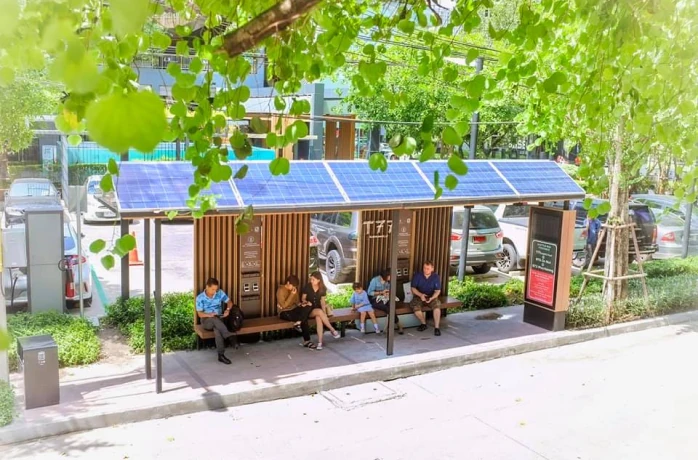
Solar panels were installed in the parking lot of the Siri Campus building
-
Enhancing clean electricity production by over 10,832.4 kilowatt-hours per month and decreasing greenhouse gas emissions by over 5.41 tonnes of carbon dioxide equivalent per month.

Efforts in waste separation and recycling were encouraged, resulting in a reduction of 2,463 tonnes of waste
-
Which is equivalent to a decrease of 668 tonnes of carbon dioxide equivalent.

Clean energy was implemented in residential projects, with solar panels generating 975,347 kilowatt-hours, which accounts for 10 percent of total energy consumption
-
For low-rise projects: 761,118 kilowatt-hours, leading to a reduction of greenhouse gas emissions by 342.5 tonnes of carbon dioxide equivalent.
-
For high-rise projects: 214,229 kilowatt-hours, resulting in a reduction of greenhouse gas emissions by 96.4 tonnes of carbon dioxide equivalent.


Energy Consumption Rate
(Unit: Gigajoules)

Sansiri has implemented energy reduction measures through the enhancement and investment in new equipment and technology, alongside initiatives to encourage employee engagement in energy conservation. The Company has instituted follow-up measures as well.

The increase in energy consumption is attributable to Sansiri's shift to electric vehicles for its corporate fleet and employee shuttles, alongside the Company’s continued support for employees. Nonetheless, Sansiri has assessed its operations and implemented more rigorous energy management measures in other areas to ensure alignment with its targets for the upcoming year.
Relevant Stakeholders

Investors and Shareholders

Customers, Tenants and Residents

Suppliers and Business Partners
